Build Skills. Improve Performance. Create a Stronger Organization.
OINDC provides structured training and certification-oriented programmes for employees, workers, supervisors, managers and business leaders—designed around competency gaps, business requirements and measurable workplace improvement.
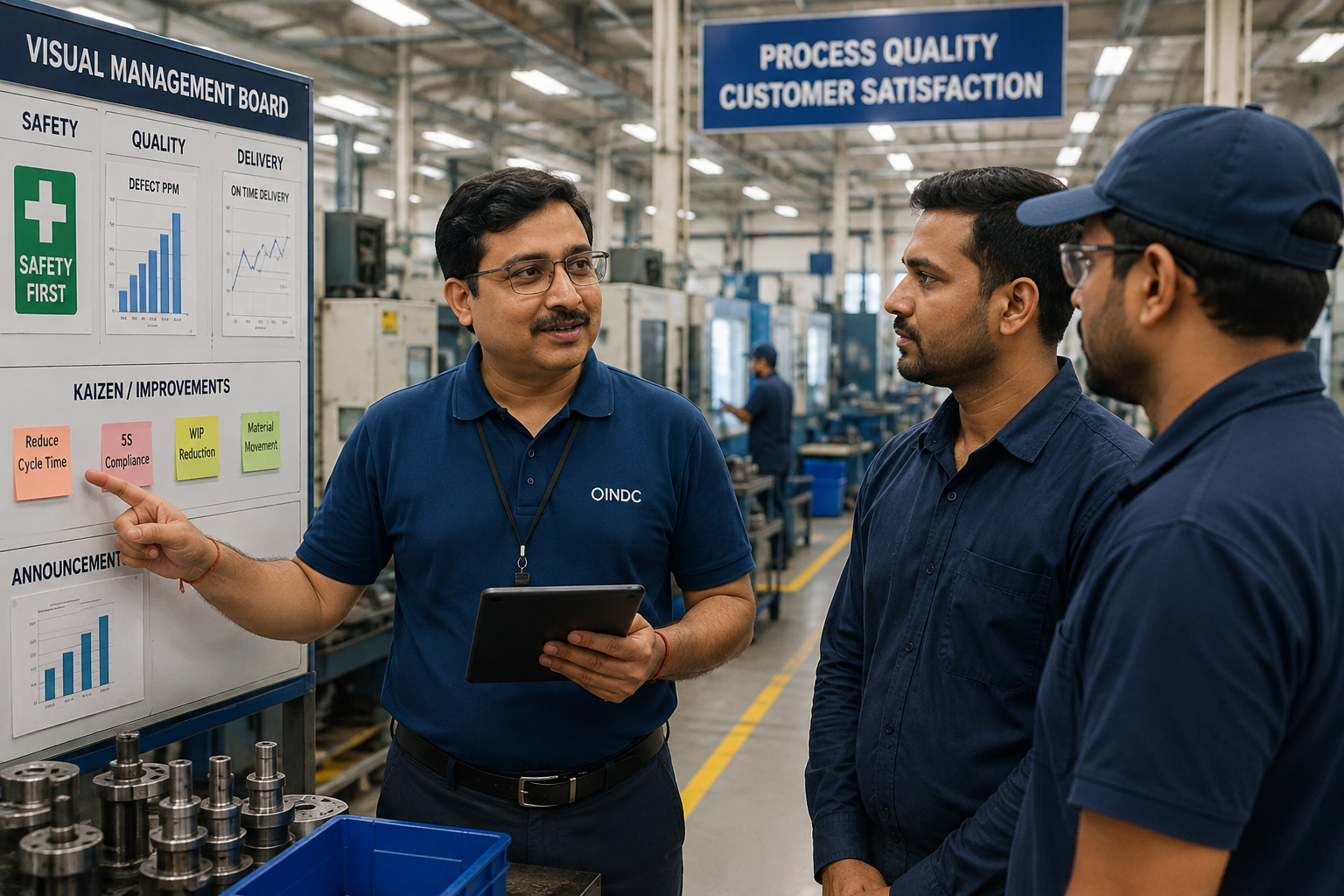
Important Statement: OINDC issues participation/completion certificates for its training programs. Competency assessment certificates are issued under defined evaluation criteria. External, accredited, or third-party certifications are conducted and issued by the respective authorized certification/examination bodies.
Training Should Solve a Business Problem—Not Just Fill a Calendar.
Organizations often conduct training because it is planned, required by a customer, expected during an audit, or included in an annual calendar. But effective training starts with a more important question: what capability does the business need, and what gap is preventing the employee from achieving the expected result?
OINDC helps organizations identify competency gaps, define training needs, conduct structured programmes, assess learning and verify workplace application.
Why Training Matters for MSMEs
OINDC Training Capability System
A structured 9-step pathway from gap identification to certified competency.
Need, Role & Gap Identification
Identify business objectives, define role-wise knowledge/skills, and measure skill gaps using a competency matrix.
Planning, Delivery & Assessment
Prioritize training calendars, conduct interactive classroom/shopfloor training, and evaluate learning retention.
Application, Improvement & Certification
Verify workplace application, close residual skill gaps, and issue verifiable participation or competency records.
Comprehensive Training Categories
Customized programs tailored for shopfloor operators, supervisors, quality teams, and executives.
Core Tools & VDA/IATF
APQP, PPAP, FMEA, MSA, SPC, 8D Problem Solving, and IATF/VDA awareness.
5S, Kaizen & Lean Tools
8 Wastes, 5S workplace organization, Kaizen, SMED setup reduction, and VSM.
7 QC Tools & CAPA
Inspection techniques, Fishbone/5-Why RCA, CAPA execution, and defect prevention.
Internal Auditor Training
Auditing techniques for ISO 9001, 14001, 45001, 27001, IATF 16949, and AS9100D.
Supervisor & Shift Leadership
Shopfloor communication, line balancing, discipline, and daily target management.
Safety & Risk Awareness
PPE usage, hazard identification, emergency response, and chemical safety awareness.
KRA / KPI & Performance
Goal setting, role clarity, interview scorecards, and management review systems.
Machine & Process Skill Setup
Drawing reading, precision instrument usage (verniers, micrometers), and SOP compliance.
4-Level Training Effectiveness Model
Flexible Delivery Formats
What Skills Does Your Team Need to Improve?
Tell OINDC about your workforce, business requirements, and current training challenges. We will help identify training needs and design a practical program.
Plan Training for My Team
Training & Certification FAQ
Clear answers regarding program formats, certificates, and recognition.
What types of certificates does OINDC provide?
OINDC issues Participation or Completion Certificates upon fulfilling program requirements. Competency assessment certificates are issued where defined evaluation frameworks apply. Third-party or accredited certifications are awarded by accredited examination bodies.
Can training be conducted directly at our factory floor?
Yes. On-site plant training allows operators and supervisors to apply concepts directly to their actual machines, work instructions, and check sheets.
Can OINDC help conduct a Training Needs Assessment (TNA)?
Yes. We evaluate your business goals, rejection trends, audit findings, and competency matrices to build an annual training calendar.
Turn Training Into Measurable Capability.
Identify skill gaps, build structured training programs, and measure workplace effectiveness.